Sunday, April 30, 2017

Large ALICE pack

I own a large ALICE (All-purpose Lightweight Individual Carrying Equipment) pack. User manual. More here.

It's not an ALICE pack I was issued as a soldier, but rather one I purchased on eBay for a schoolmate who was a Marines officer candidate having trouble with the ruck march portion of the qualification course. He stopped practicing with it because one of the shoulder straps would slide and lengthen under load due to insufficient grip by the blunt teeth on its adjustment buckle. After he returned the ALICE pack to me, I found out that when the adjustment buckle is squeezed into the strap, it grips enough for the shoulder strap to be usable. The shoulder strap will still gradually slide when the pack is under load and needs to be periodically tugged to shorten it, and if I were a soldier, I'd DX the ALICE pack. For a civilian, it works acceptably adequately.

I don't remember how much I paid for it. I believe I bought the cheapest complete large ALICE pack, which includes the frame, shoulder straps, and lower back strap, listed on eBay at the time because it was meant for my schoolmate to practice ruck marching, not for general use as a backpack. It's worn. ALICE packs are described as water resistant, not water proof, and soldiers are issued dry bags to use in their rucksacks. My ALICE pack hardly resists water at all. In a rain storm, it takes in water like it's made from cotton. The OD green paint on the frame has many chips exposing the aluminum. The rivets on the frame are loose, so the crossbars squeak and clack under load. One of the metal keepers on the top of the frame is bent. There's a roughly centimeter square hole on the top of the main flap and multiple patches spread over the pack. The tie down straps are frayed and thinned. The edges of the frame attachment webbing are frayed. The strap for the inner compartment and draw cords for the 2 side large outer packets are missing. There's a hole at the bottom of the inner compartment where the stitching is missing; the hole might have been made on purpose. Some stitching is also gone, likely worn away, on the edges of the large outer pockets. The envelope that fits the pack onto the frame is stretched and worn like the rest of the pack. The velcro on the main flap pocket is weakened. The snap is missing on one of the quick-release straps; it's secured with a piece of 550-cord sheath. But for all its wear and tear, the integrity of my ALICE pack is sound. It's a rugged piece of equipment.

The bottom of the main flap pocket is white mesh with traces of faded dark greenish coloration, which is different than the rubberized plastic at the bottom of the main flap pocket in the ALICE packs I used as a soldier. I wondered whether the plastic was stripped out or whether the ALICE pack I bought on eBay is real military surplus. Then I saw this video by a former USAF SERE instructor featuring a medium ALICE pack he's owned since 1986 as a 16-year-old. Its main flap pocket also has a white mesh bottom. I guess his medium ALICE pack was manufactured sometime between the mid 1970s and early 1980s while the ones I used in the Army were a later version. My ALICE pack looks like it could have weathered hard use for 20+ years before I bought it.

I added a handle fashioned from cobra-stitched 550-cord to the top of the frame tied on with plastic fishing line, replacement draw cords for the 2 side large outer packets fashioned from 1/16-inch kernmantle accessory cord tied with poacher's knots into compression knots, a replacement inner compartment strap using a plastic mesh sleeve that held garlic bulbs, a pair of used shoe insert pads to the shoulder side of the shoulder pads tied on with shoestring, and shims fashioned from egg carton styrofoam at the base of the vertical cross bar tied on with dental floss. Hopefully, the shims will solve the creaking and clacking from the vertical crossbar when the ALICE pack is under load due to the loose rivet at its base.

Mitch Mitchell from season one of Alone has an interesting series on youtube in which he modifies a new large ALICE pack by removing the 3 small pockets and then sewing on a large center pocket in their place that he removed from his old large ALICE pack. His series provides insight on how the ALICE pack is stitched together. His old large ALICE pack has a white mesh bottom in the lid, like mine, and the mesh also appears to have some faded dark coloration. He says the waterproofing has worn out from the lid. His ALICE pack took in water in a rainstorm like mine and he treated his ALICE pack with silicone.

Eric

Labels:

. . . tell me more.

Sunday, February 22, 2015

New York Times writer posits "Thank you for your service" is offensive to veterans. I disagree.

Byron Wong at bigWOWO asks:
Hey Eric,

I just saw this:

http://www.nytimes.com/2015/02/22/sunday-review/please-dont-thank-me-for-my-service.html?emc=edit_th_20150222&nl=todaysheadlines&nlid=29649347

I'd be interested in your opinion. Could you blog about it? (I usually don't request this, but I think lots of people might also be interested.) All considered, I think the vets are right about those who don't serve--it's what you're supposedly supposed to say, without any kind of thought.
Byron,

Sure.

I was a soldier and, thus, I will always be a veteran. I have advocated for veterans in the civilian-military context. I have been thanked for my military service, so I have some insight on the topic. That being said, I qualify my reactions to Matt Richtel's article with I am not a 9/11-generation war veteran and even if I were, veterans are opinionated individuals with diverse takes on being thanked for their military service.

Reactions:

_Mr. Richtel's article would have been better rounded had he teamed with a thoughtful veteran, preferably a contemporary 9/11-generation war veteran, as a co-author.

Nonetheless, the perfect is the enemy of the good. I encourage people like Mr. Richtel to explore, however imperfectly, veterans issues from the civilian side of the civilian-military divide. His article implies that veterans prefer a social firewall to shut off acknowledgement and conversation from civilians who are not members of the American military fraternity and lack the basic framework to understand it. Perhaps some veterans feel like that. Not all do. I don't believe most veterans feel like that. I take a different tack. In college, creating a vital civilian-military cultural interface was a foundational reason for starting MilVets. Bridging the civilian-military divide has carried forward as a core element of MilVets' mission on campus and, for years, the group has been almost entirely 9/11-generation war veterans.

_The response from Tim O'Brien, author of The Things They Carried, highlights a key point that I feel strongly about, too: the politics of war matter to veterans.

We know when we volunteer that selfless service and sacrifice, potentially of our lives, are part of the deal. They're core elements of American military heritage. By oath, we trust up front that our nation's leaders will invest our lives in worthy causes. That doesn't mean, however, soldiers don't care about the politics of war. Of course they care; they live the wars and stake their lives in them. It mattered to me why my fellow American soldiers and I should potentially die defending Koreans from Koreans. The same question has been asked about the wisdom of Americans dying to defend Vietnamese from Vietnamese, Somalis from Somalis, Slavs from Slavs, Iraqis from Iraqis, Afghanis from Afghanis, and possibly someday, (Taiwanese) Chinese from (mainland) Chinese. The question really is one of fundamental premise: should America be a 'leader of the free world' at all that stakes the lives of America's sons and daughters for the sake of other peoples across distant shores.

Other than outliers like Ehren Watada, the politics of war take a backseat for soldiers while they're engrossed with the tasks, conditions, and standards of the mission at hand, and keeping their men, their buddies, and themselves sound. But the why and the outcome of the war matter very much to veterans when they reflect on their experiences, contextualize them in narrative form, and weigh the consequences for their own lives, their families, their comrades, their country, the people over there, and the world.

What categorically separates 'good' wars from 'bad' wars is the prevailing narrative of the why and outcome. While the wars viewed as honorable in the zeitgeist are just as harsh in their ground and personal effects as the wars viewed as dishonorable, the prevailing narrative sets the contextual frame that colors the social value of a veteran's military service. For that reason, it's critical for the sake of Iraq veterans to correct the political distortions of the law and policy, fact basis or justification — the why — of Operation Iraqi Freedom, more so since the long-term outcome of their mission has been thrown off track. Setting the record straight in the zeitgeist is most important for the young children of our KIA in Iraq who will only ever know their father or mother through the prism of the cultural legacy of the Iraq War.

_How have I personally felt when I've been thanked for my military service? A bit awkward.

The conventional responses to "Thank you", such as "No problem" or "You're welcome", don't squarely fit because overseas military service, generally speaking, is a national security action in the global context for the sake of the collective us. National security (i.e., national defense, foreign relations, or the economic interests of the United States) is not the same thing as homeland security. Overseas military service is not a direct conveyance from American soldier to American (civilian) citizen, unlike say, a Coast Guard sailor or National Guard soldier who directly engages fellow Americans while serving on a search-and-rescue, peacekeeping, or disaster relief mission in the homeland. The good of my service in a national security mission in Korea to my fellow Americans was collective, indirect, and largely abstract.

As such, I would advise veterans who feel cynical like Hunter Garth to not interpret the statement, "Thank you for your service", from the viewpoint of their personal relationship with the thanker. Instead, they ought to adopt a more social view that a citizen on behalf of the nation is expressing civic appreciation to a soldier or veteran as a representative of the military's greater contribution to the collective us as the American nation.

The same civic concept underlies the "any soldier" letters from American schoolchildren that are distributed randomly to soldiers serving overseas. As a 20-something soldier in Korea, I felt awkward and vaguely objectified receiving a handwritten letter from a 4th grader in Ohio thanking me, too. The letter wasn't to me, though. It was to an American soldier serving over there and I was an American soldier serving over there.

I've summarized the abstract social value of military service and the civic appreciation thereof thus:
It truly is selfless service – a lot of love and pride goes into soldiering. It doesn’t matter why someone joins or where he came from, or how much he enjoys (or suffers) his duties. It doesn’t matter who’s making the tough decisions in the White House. Soldiers are part of a heritage that is older, deeper and more essential than the republic for which they sacrifice. Soldiers are of the people. They are the primal embodiment of the social contract we make with each other to be a civilization.

Now, and in all times, our soldiers, marines, sailors and airmen deserve the American people’s gratitude and understanding.
The summary follows from the way I counseled the new soldiers assigned to my care: You're a professional soldier of the United States Army now. Never forget that on your chest, you are telling the world at all times what you represent — your country, your Army, your family.

In my opinion, when a veteran is being thanked for his service by someone who has not served, likely will never serve, and doesn't know what it's like, the proffer of gratitude is not attuned to the veteran's individual service experience. But the expression is not meaningless. The veteran is being thanked by a fellow countryman less for his own sake than as an affirmation of something essential the veteran is part of that is bigger, deeper, and older than himself, that in fact is deeper and older than the American nation. He should accept it as a civic cultural ritual and not reject it as an unintended affront. The thank-you is not personal. It's for "any soldier" and the veteran represents "any soldier" who has served bearing his country, his Army, his family name over his heart.

Perhaps formulating a ritualistic response for veteran thankees would help alleviate the awkwardness of being thanked for our service. I suggest responding with "It was an honor", which deflects the individual aspect and focuses the exchange, instead, on the timeless collective aspect of military service.

Post-script:

To expand a bit on my post, "Thank you for your service" is viewed properly as a civic cultural ritual rather than a unique transaction between individuals. As with any ritual, though, "Thank you for your service" functions only when the meaning and context of the ritual are mutually understood and the underlying ethic is shared by its participants. As ritual, the key pieces currently missing are, one, a common cultural understanding of "Thank you for your service" as an affirmation of a fundamental social value rather than a comment on an individual experience and, two, a formulaic ritual response by the veteran thankee. I suggest the response, "It was an honor", to focus on the timeless collective aspect instead of the particular individual aspect of the veteran's military service.

As analogy, the ritual of the Eucharist is not a quick, thoughtless, throwaway substitute for the spectrum of Catholicism. Rather, the brief ritual is an entry point for the larger clockwork of believing and practicing the faith. "Thank you for your service", properly understood and practiced, should function similarly within a larger clockwork of (secular) civilian-military relations. When the context of the ritual of the Eucharist is subtracted, then the Communion bread becomes just a piece of wheat bread. Ritual context should be added to "Thank you for your service".

Eric

Labels:

. . . tell me more.

Tuesday, December 16, 2014

The Army all-weather coat

Excerpt from pages 128 to 129 of DA PAM 670–1 • 2 December 2014:

20–7. Coats, black, all-weather (male and female)
a. Type. The black, all-weather coat is a clothing bag issue item.
b. Description. The black, all-weather coat is made of polyester/cotton (65/35) in Army shade 385. The coat is a sixbutton, double-breasted model with a belt, convertible collar that buttons at the neck, gun flap, shoulder loops, adjustable sleeve straps, welt pockets with two inside hanging pockets, and zip-out liner. The back of the coat has a yoke and center vent. The coat is one-quarter lined with basic material; the sleeve lining is made of nylon taffeta (see fig 20–7). There is no wear-out date for the interim version of the double-breasted coat made from polyester/cotton (50/50).


Figure 20–7. Army black all-weather coat with officer insignia


c. How worn. Personnel may wear the all-weather coat with or without the liner. They will wear the coat buttoned, except for the neck closure, which personnel may wear open or closed (unless otherwise prescribed by this pamphlet). Male and female coats are buttoned and belted from opposite directions. The black scarf is authorized for wear with the all-weather coat. Personnel may wear the coat with the service, dress, mess, hospital duty, and food service uniforms. The black, all-weather coat is authorized for wear with utility uniforms only in a garrison environment when personnel have not been issued organizational rain gear. Officers wear nonsubdued pin-on grade insignia on the shoulder loops of this coat. Noncommissioned officers wear shoulder marks on the shoulder loops. Enlisted personnel wear nonsubdued grade insignia on the collars. When the grade insignia is removed from the coat, personnel may wear the coat with civilian clothing.

The basic design of the Army all-weather coat has not changed since at least World War 2, though the regulation color at that time was khaki, not black. It was worn in the field during World War 2, which is no longer the case. The modern place of the Army all-weather coat is with the sterile wear of fastidious Class A and Class B uniforms rather than the rough wear of rugged Class C uniforms. While its basic design has not changed since World War 2, I guess the contemporary construction of the Army all-weather coat is no longer rugged enough for wear in the field.

Due to the suggestive name and military origin of the coat, a common assumption is the gun flap below the right shoulder is related to firearm use, perhaps a vestige of a pocket for a pad to cushion the butt of a rifle. Actually, the gun flap covers the open edge of the convertible collar when buttoned at the neck to keep water from running inside the coat. It may be called a gun flap because raising the right arm, such as when using a rifle, tends to open a gap between collar and coat that lets in water. The gun flap is also called a storm flap, which better indicates its purpose. Closing the convertible collar does a good job holding body heat in the cold as well as keeping water out in wet weather.

The common name for the Army all-weather coat is the trench coat, derived from its use in the trenches of World War 1. More on the history of the trench coat here.

Eric

Labels:

. . . tell me more.

Sunday, July 27, 2014

Moral dilemma, Lone Survivor, Torture Report

Comment at this post about the possible declassification of a Senate Select Committee on Intelligence report on the use of torture in the War on Terror:
It’s a moral dilemma to be sure.

Last week, I watched the movie, Lone Survivor. It’s based on the account by former Navy SEAL Marcus Luttrell whose team, along with a Chinook crew and whole squad of SF operators, were killed in action.

Nineteen of the US military’s best men died because PO Luttrell’s commanding officer, LT Michael Murphy, decided to release 3 prisoners – 1 old man and 2 boys – rather than kill them outright or bind them, which the SEALs believed would likely result in their deaths (animal predators, weather).

LT Murphy made his decision in accordance with his morality, the rules of engagement, and laws of war. He also made this decision expecting that his erstwhile prisoners would inform the nearby Taliban forces of his SEAL team. These particular Taliban were known to be responsible for, and thus capable of, killing US Marines, which is a hard thing to do.

Nineteen of America’s best men, many of whom were husbands and fathers of young children, were killed because LT Murphy made an all-American moral decision, the kind we teach our soldiers to make with their dedicated ethical training from the earliest stage of their military indoctrination.

His only reprieve is that he didn’t survive long enough to see his close comrades in the rescue squad, whom he had called to save his team with his last act in life, also die as a result of his moral decision to spare the lives of the old man and 2 boys who would kill him and his men.

LT Murphy honored the highest traditions and values of the US military and was awarded the Medal of Honor, posthumously.

The moral dilemma of “enhanced interrogation” does not rise to killing old men and young boys who accidently stumble on a secret op. It’s usually not even torture by the standard of our enemy in the War on Terror.

But the other side of the moral dilemma of “enhanced interrogation” is even heavier than the life-or-death choice that faced LT Murphy and killed him.

Rather than LT Murphy’s own life, the lives of the three men in his command, and even the doomed rescue team he didn’t live to see, our interrogators are tasked with preventing the killing of 10s, 100s, 1000s, maybe even 10000s or more – depending on the kind of weapon the terrorists can obtain from terrorist supporters like Saddam – civilians, not just soldiers. Interrogators are charged with protecting the homeland itself.

When the Abu Ghraib scandal broke, I was disgusted, as was every other Army veteran I knew. But my reaction was tempered by the appreciation that the terrorists were assassinating and mass-murdering 10s and 100s of Iraqis at a time, almost every day, along with humanitarian aid workers and the coalition soldiers defending Iraq. Our interrogators at Abu Ghraib were wrong … but they were wrong while trying desperately to save American, coalition, aid workers, and most of all, Iraqi lives by stopping an enemy who was – and is – zealously committed to achieving social dominance through unrestrained terror-style murder and real torture.

Our morality – Michael Murphy’s morality – demands our judgement that certain acts are wrong and intolerable. Had I been in command, I’m certain I would have made the suicidal [and fratricidal] decision that LT Murphy made. I also would have penalized the interrogators and MPs at Abu Ghraib.

But know that that our morality, while we are competing with this enemy, comes with a very, very high price. At least consider the price when you judge.
Add: CIA Saved Lives.

Eric

Labels: ,

. . . tell me more.

Friday, July 04, 2014

The oaths I've taken

In honor of the 238th birthday of the United States of America, the oaths I've taken:

"I, _____, do solemnly swear (or affirm) that I will support and defend the Constitution of the United States against all enemies, foreign and domestic; that I will bear true faith and allegiance to the same; and that I will obey the orders of the President of the United States and the orders of the officers appointed over me, according to regulations and the Uniform Code of Military Justice. So help me God." (Title 10, US Code; Act of 5 May 1960 replacing the wording first adopted in 1789, with amendment effective 5 October 1962) *

"I, (your name), do solemnly swear that I will support the Constitution of the United States, and bear true allegiance to the National Government; that I will maintain and defend the sovereignty of the United States, paramount to any and all allegiance, sovereignty, or fealty I may owe to any State or Country whatsoever; and that I will at all times obey the legal orders of my superior officers, and the Uniform Code of Military Justice." (The Cadet Oath taken upon entering the United States Military Academy) *

Eric

* Originally posted 7/23/2007 11:17:00 PM

Labels: ,

. . . tell me more.

Monday, November 11, 2013

Veterans Day 2013

On this Veterans Day, over twelve years since the 9/11 attacks galvanized our resolute military response, American soldiers continue to serve on the ground over there, competing with their lives for the shape of the world that we pass on to our children.

Military historian T.R. Fehrenbach: “You may fly over a land forever; you may bomb it, atomize it, pulverize it and wipe it clean of life—but if you desire to defend it, protect it and keep it for civilization, you must do this on the ground, the way the Roman legions did, by putting your young men in the mud.”

Army Lieutenant Ben Colgan was the subject of my 1st post on this blog. A little over 10 years ago, on 01NOV03, he was killed in action while leading his platoon dynamically in the post-war, peace-building mission in Iraq. Men and women like LT Colgan are the best of our American generation.

I've said this before and today is a good day to say it again: Young veterans need to become a social movement.

Eric

Labels: ,

. . . tell me more.

Wednesday, August 28, 2013

Cool website of the day: Boy Scout Skills

Boy Scouts of America Troop 780's Boy Scout Skills.

The website looks well organized. I can't confirm its content is a full and accurate representation of Boy Scouts skills, but it looks comprehensive.

If I could do over my boyhood, I would be a Boy Scout. That doesn't rise to a regret over a wasted opportunity because I wouldn't have considered joining the Boy Scouts if I hadn't been a soldier. As a soldier, I discovered that the Boy Scouts' skills and core values transfer well to soldiering. Every boy who aspires to join the Army should be a Boy Scout.

Wes Anderson's phenomenally capable Khaki Scouts in Moonrise Kingdom are an effective advertisement for the Boy Scouts of America and the revaluated Trail Life USA.

Add: Scouting Resources UK, a British scouting website, looks to be comprehensive. Ian's take and Keoni's take on Scouting.

Eric

Labels: ,

. . . tell me more.

Sunday, May 12, 2013

Castillo

Character always wins out.

This story doesn't surprise me.

I knew Sergeant First Class Raymond Castillo as Cadet Candidate Castillo when we were CCs together at USMAPS. I was older, prior service, and higher in the class ranking; nonetheless, I admired him. As young as he was, Castillo shone with the right stuff even then. He was thoughtful, self-aware, tough, and a true believer of duty, honor, country — a born soldier. More, Castillo was a born leader of soldiers in the ideal sense. Even then, he was sure in his principles and lived and breathed the Army values. I wasn't surprised that Castillo enlisted and joined the Infantry after leaving USMAPS. The only reason he didn't make it to West Point with the rest of us was he couldn't write despite that the best CC writers at USMAPS, including me, did our best to tutor him. It was frustrating because Castillo was smart enough, otherwise a good student, skilled at math, well-spoken, willing to learn, and a hard worker. If he would have simply written his papers the same way he spoke, he would have been fine, but for some reason, there was a disconnect in his brain between his mind and his writing.

Castillo will always be one of my favorite people. My civil-military advocacy in college and my efforts to counter misrepresentations of the Iraq mission were motivated by soldiers like him. They are good, honorable men — worthier, stronger men than I am — the best of Americans who have risked themselves for duty, honor, country. They've earned it. They are righteous. They deserve to be empowered and honored for their selfless service and sacrifice.


Also see Army Lieutenant Benjamin Colgan, Happy Veterans Day: Call to Duty: Boots on the Ground, and New York Times writer posits "Thank you for your service" is offensive to veterans. I disagree..

Eric

Labels: ,

. . . tell me more.

Friday, May 10, 2013

Thoughts of the day

I agree with Ethan Chorin that President Obama's misguided Libya policy set the stage for the Benghazi consulate attack and other deleterious effects. For a liberal leadership posture, Bush's Middle East policy was correct. By retaining the same liberal posture yet switching course based on the faulty premise that Bush's Middle East policy was incorrect, Obama's Middle East policy has gone wrong.

2004 CNN report with Clinton supporting Bush on Iraq:
Clinton, who was interviewed Thursday, said he did not believe that Bush went to war in Iraq over oil or for imperialist reasons but out of a genuine belief that large quantities of weapons of mass destruction remained unaccounted for.

Noting that Bush had to be "reeling" in the wake of the attacks of September 11, 2001, Clinton said Bush's first priority was to keep al Qaeda and other terrorist networks from obtaining "chemical and biological weapons or small amounts of fissile material."

"That's why I supported the Iraq thing. There was a lot of stuff unaccounted for," Clinton said in reference to Iraq and the fact that U.N. weapons inspectors left the country in 1998.

"So I thought the president had an absolute responsibility to go to the U.N. and say, 'Look, guys, after 9/11, you have got to demand that Saddam Hussein lets us finish the inspection process.' You couldn't responsibly ignore [the possibility that] a tyrant had these stocks," Clinton said.

As shown by Clinton's quote, the Democrats understood the context and stakes in Iraq, yet they still distorted the public perception of the Iraq mission for parochial partisan gain. This postsecret from May 18 reminds me of the layers of damage caused by the misinformation, propaganda, and false narrative against the Iraq mission that the Democrats validated. Let's see whether this and this make a difference.

Bravo, Richard Kemp. More of this needs to be said and often about our roles in Iraq and Afghanistan. I would emphasize more the liberal and humanitarian aspects of our peace operations, but he takes the narrative in the right direction by critically spotlighting and contrasting the nature of the enemy. We need a better, stronger narrative. The leftist anti-peace narrative works hand in hand with the Islamic terrorist narrative to deadly result.

Bravo, Michelle Malkin. This is the right tack to criticize Obama's hypocrisy and overreach, and rehabilitate Bush's legacy while not throwing out the baby of national security and the War on Terror with the bathwater. Make Bush the standard and hold Obama to it.

I haven't been following the Jason Richwine controversy, but here's his side of it. Judgybitch's take.

Abandoned places, such as the abandoned showpiece City Hall subway station.

Youtube fun:
Schmoyoho's (Gregory Brothers) Churchill remix. Churchill is a soul brother.
A red-pill song by Matt Hires: Restless Heart.
The Crazy Nasty Ass Honey Badger (original narration by Randall).

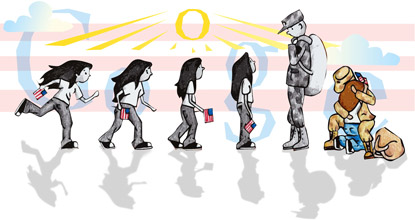
Touching google doodle of a girl excited, then apprehensive and tentative, then finally released and intimate with her military dad when he comes home from a deployment. The theme is Best Day Ever and the artist is contest winner Sabrina Brady.

Who you are, character, personality, intrinsic self, inner game is determinative. It always wins out. Talent, skill, resources, given advantages, and luck are just tools. What you do is episodic. Character is thematic. In the end, you are what your record says you are.

Free Northerner's manly reading lists. Compare to Columbia's renowned Core Curriculum.

Project Gutenberg - classics for free on-line.

Story of a family who travelled from a Lockean state, the UK, to visit family in India and fell into a Hobbesian nightmare.

At some point, I'll make a separate post for Szelenyi's lectures, like my knots progress post.

What's happening to good-girl paragon Amanda Bynes? Her fall is yet another harsh disillusioning blow to my idealism where a hitherto unimpeachable American paragon is brought low in shocking and/or sordid fashion, like Lance Armstrong, Alex Rodriguez, Lehman Brothers, Columbia space shuttle, GEN Petraeus, Bernie Madoff, Tiger Woods, Horace Mann, Catholic church, and Penn State. Bynes was seemingly the most stable and virtuous of her peers, yet her fall has been the hardest. It's like Taleb's black swan enacted on a personal level. Insight from Mara Wilson.

A red-pill explanation for Bynes's breakdown: The truth about female desire: It’s base, animalistic and ravenous. It may be, at least in part, her nature breaking free.

Duke of Earl by Gene Chandler. "As I walk through this world, nothing can stop the Duke of Earl ... Nothing can stop me now, coz I'm the Duke of Earl!"

Goodnite, Sweetheart, Goodnite by the Spaniels. "Good night, sweetheart, well, it's time to go. I hate to leave you, but I really must say, oh good night, sweetheart, good night." "Baby, I just can't get right. Well, I hate to leave you, baby, I don't mean maybe, because I love you so." That's what it felt like when I left Korea, the Army, and her behind. To summarize, Every Little Thing She Does is Magic by the Police, Can't Fight This Feeling by REO Speedwagon, Teenager in Love by Dion and the Belmonts, and Goodnite, Sweetheart, Goodnite by the Spaniels sing the love story that wasn't. Rollo explains the 'click' together but ... mystery.

Sorrow.

Honor your father and mother by begetting children.

Sarah at Trying to Grok regrets waiting too long to start having children and recommends women should start their families before age 25.

Narcotics Anonymous: "Insanity is repeating the same mistakes and expecting different results."

7 stages of grief (modified Kubler-Ross): Shock - Denial - Anger - Bargain - Depression - Testing - Acceptance.

Pulp Fiction Ezekiel 25:17 (the whole scene; revisited in the final scene). "The path of the righteous man is beset on all sides by the inequities of the selfish and the tyranny of evil men. Blessed is he who, in the name of charity and good will, shepherds the weak through the valley of darkness, for he is truly his brother's keeper and the finder of lost children. And I will strike down upon thee with great vengeance and furious anger those who would attempt to poison and destroy my brothers. And you will know my name is the Lord when I lay my vengeance upon thee!"

No matter how much a drill sergeant yells at you while smoking you (and your fellow privates) in the pit or anywhere else, muscle failure is muscle failure. Where the drill sergeant makes a difference is your muscular capacity is higher than your perception of your muscular capability. The drill sergeant bullies you past the limits of your perception, gets more out of your capacity, and thereby improves your capability more than you would have on your own.

Principle is fine - it's the ought. But power comes first - it's the real that is.

Andy Greenwald on the moral of the Game of Thrones's Red Wedding - the practical purpose for the fiction of idealism and the danger of codes of honor: "Jon Snow is a bastard, born outside of the tight web of convention that gave Ned meaning and purpose, the same fiction that Varys spoke of a few weeks back as being essential to keeping an empire from falling into chaos. While there's enough Ned in him to save the life of the elderly horsetrader — and blow his own cover in the process — Jon's still fluid enough in his worldview and allegiance to keep him alive for the foreseeable future." Rational choice wins. Greenwald's post is worth reading even if you (like I) haven't watched the show. It's a prescription for the red pill. "Greater good", "make a difference", and "make the world a better place" can be spun, interpreted, and modified to mean a number of different things.

Related to that the frame of the problem informs the solution, knowing parties, premises, (first) principles, purpose, and definitions tells you the rest.

I made myself a bannock pizza deep dish style using my 3 quart mixing bowl in the Nesco. It worked. The crust tasted, looked, and felt (texture) like a reasonable approximation of a deep dish pizza crust. I left the bannock dough in the refrigerator overnight because I wasn't hungry. I learned that chilled bannock dough, like chilled brownie batter, also flour based, is easier to work with than just-made bannock dough. The cooked crust seemed thicker than usual, too. I'm not sure whether it tasted different, though the bitter taste from the baking soda seemed less.

This time, I let the Duncan Hines dark chocolate fudge brownie cool completely before eating it. Cooled, but not cold, the texture was more brownie-like and seemed to taste better, too.

I tried mixing evaporated milk into my last dark chocolate brownie mix. The result was the consistency was more brownie like. Still low on taste, though.

I bought Duncan Hines dark chocolate fudge cake mix on sale for 1.25 for a 16.5 ounce box. Ugh. It's tasteless, more tasteless even than the Duncan Hines dark chocolate fudge brownie mix. Granted, cakes are meant to be frosted, but the cake portion should have at least some flavor. The texture is cake texture rather than the relatively denser brownie. Adding evaporated milk to the cake batter makes the cake spongier.

I wonder why chicken takes longer to cook than pork. Less dense muscle fiber?

Golden Krust honey barbecue jerk sauce is quite tasty as a dipping sauce. Hunts hickory & brown sugar barbecue sauce is too strong as a dipping sauce and okay as a pre-cook baste - quite sticky, though, due to the corn syrup.

The turkey sausage is a pain in the ass. I just ate 2 bites that were half raw. How am I supposed to know the inside is no longer pink? I'm going to try boiling one next time before I grill it, like how I broil my pork before grilling it. I'm just afraid the tasty oil will leak out of the sausage when I boil it.

.99/lb pork neck bones - not worth it for the meat. A lot of bone for broth, though.

Best Yet frozen southern selection cut okra is good. Slimy, so I cook it with my rice so the slime is soaked up in the rice.

Bachelor meat-sauce pasta shortcut: Add the uncooked pasta directly to the sauce. Add enough liquid for the pasta to plump. The Mirro and burner worked well for making the meat-sauce pasta. Bachelor meat-sauce pasta is illusory. It looks like a heaping pile (as I've noted before) and tastes okay, but it's not filling, so it goes quick.

The canned salmon makes for a decadent bachelor stew with Progresso soup. Earlier, I tried making a bachelor stew with a can of crushed tomatoes rather than soup and ended up with something like a weaker bachelor meat sauce, which I usually make with ground turkey, chicken, or pork. Today, I tried making a bachelor meat sauce pasta with the canned salmon (scallion greens, canned corn, frozen spinach, crushed tomatoes with basil). Pretty much the same result as the bachelor stew-turned-sauce. Not bad, but the canned salmon is miscast with the meat sauce. The salmon is weaker flavored with the crushed tomatoes than with the Progresso soup for some reason - tomato juice neutralizing the salmon oil, perhaps? From now on, I'm sticking with pork, turkey, or chicken for the meat sauce pasta and the canned salmon will be reserved for stew. Plus, I'm quite pleased with the Mirro so far.

With the Sunbeam wounded, I could use a skillet, frying pan, or wok for my single burner. I'm waiting for one to turn up for scavenging. I can only cook so many ways with the grill pan. At least one frying pan was available, but I declined to take it at the time because my Sunbeam was still healthy and I wasn't using my burner yet. Just goes to show, gotta think ahead.

I recovered a Circulon stove-top grill pan insert but without its holder/drip pan. It looked sort of like a skillet. I can't use it to cook without its holder unless I use it concave or underside side up, and I don't know that the underside is safe to cook on. I can't think of any other use for it. So, back in the recycling bin it goes. Oh well.

16MAY13: I scavenged an aluminum Mirro-matic electric frying pan today. I guess it was discarded because it's missing its power supply, so now it's just a frying pan, no longer electric. It's otherwise in good shape. The lid is intact and it's been scrubbed clean. It has scratches, some discolorations, and stubborn (soybean) vegetable oil stains in all the hard-to-scrub places. The key, and lucky, characteristic of the pan is its bottom fits onto my burner. The Mirro-matic has a 15-cup (120 ounce) capacity, compared to 12 cups for the 3-quart mixing bowl and 9 cups for the Sunbeam.

In cooking and other useful endeavors, the right tool for the job makes a big difference and trial and error is necessary for improvement beyond the limits of conception.

Eric

Labels: , , ,

. . . tell me more.

Wednesday, March 06, 2013

This is my first story

"This is my first story" would be a good name for a blog, or something else. For now, I'll just bookmark it by using it as the title for this thoughts of the day post. It works okay and the label function ensures I can find this post later as a thoughts of the day post. It's from this, which I know about because of this. It touches my red-pill instinct, or blue-pill programming, to be a dad and 爸爸.

I bought Chips Ahoy chocolate chip cookies on sale. The size has shrunk to 13 ounces. When I opened the package, the amount of cookies in it just looked skimpy. I'm feeling stuffed from gorging on chocolate chip cookies and whole milk, and bachelor stew with an egg, in that order. I harbor the totally baseless belief that the eater's remorseful consequences of overindulging in junk food can be ameliorated by mixing the junk food with a reasonably nutritious meal in my stomach.

Chips Ahoy chocolate chip cookies isn't the only junk food that's shrinking. I bought 1 bag regular Doritos and 1 bag Cool Ranch Doritos on a BOGO sale (2/4.29 vs the usual sale price of 2/5 or 2/6). The regular Doritos bag has been redesigned. Sale + redesign indicates a shrunken product. Sure enough, the regular Doritos bag now contains 11 oz. The Cool Ranch is 11.5 oz. Wikipedia's Doritos page displays a 12 oz bag of regular Doritos with a 3.99 labeled price. This recipe blog post from October 15, 2012 displays a 11.5 oz regular Doritos bag. Perhaps not surprisingly, most results in a google image search show Doritos bags with the weight digitally removed. And, as usual, I have eater's remorse from the Doritos and followed the chips with a real meal.

I'll fill in descriptions of my latest bachelor stew and bachelor meat sauce pasta, which I gobbled up in 2 meals (or rather 1 string of eating that spanned 2 meals), later.

Bachelor meat sauce pasta: Using my Sunbeam frying pan and Salton rice cooker, about 10 oz ground pork ($1), 28 oz can Hunts petite sliced tomatoes ($1) boosted with some Ragu sauce (Hunts diced tomatoes has tomato juice, no tomato puree), 10 oz box frozen Birds Eye frozen chopped broccoli ($1), about .5 oz remainder of 5 oz jar of HeluvaGood prepared horseradish ($1.69? for the jar), about 2/3 of 16 oz box Ronzoni small shells ($1 box), 1 chopped yellow onion (.88 2 lb bag). The amount, as usual, filled the Sunbeam, which has a 9 cup or 72 oz capacity. I started eating it at breakfast and kept picking at it until it was gone by lunch. It's a reliable comfort-food dish.

Bachelor stew: Using my 3 quart mixing bowl, Nesco, and Salton rice cooker, 14.75 oz can Icy Point pink salmon ($3), 18.5 oz can Italian-style Wedding (meatballs, carrots, and spinach in chicken broth) Progresso soup ($1.50), 10 oz box Best Yet frozen whole leaf spinach ($1), about 6 oz remainder of 24 oz jar Old World Style Traditional Ragu sauce ($1), 1 chopped yellow onion (.88 2 lb bag), 1 cup cooked rice ($10 20 lb bag). I later added about 32 oz of porkbone broth, but I don't think it made a difference from water. The stew costs more than my meat sauce pasta, but it makes for decadent eating.

Boneless pork sirloin chops - yum. I bought a 2.23 lb chunk on sale for $1.59/lb, rubbed on some seasoning salt and pepper, put it in the Nesco and left it alone to cook. 45 minutes later, tender meat. Easy. Pork has emerged as my favorite of the 3 meats. Pork is savory, forgiving to cook, and filling. Pork sears well. Beef is the most expensive of the 3 meats. It's not forgiving to cook and too easy to overcook. Beef tastes good when it's right, but it's tasteless when I get it wrong. Granted, I'm buying cheap cuts of beef, which makes a difference. Chicken is the cheapest of the 3 meats. It's forgiving to cook; I've overcooked chicken with much too high a temp for much too long and it still tasted like chicken. I like thigh meat the best. The downside is chicken is the least filling of the 3 meats; it's like the Wonderbread of meat.

I bought a 12 oz bag of BacalaRico Choice Boned Salted Alaska Pollock Fillets on sale for $2.50. These instructions on pan frying fish fillets seem simple enough. I'm just going to flour and fry the fillets in the Sunbeam, not egg and bread them. Update: I followed the instructions and soaked the fillets in water, changing the water 3 times, but they were still salty - over-seasoned salty, not preserved-in-salt salty. I don't know that it's worth the higher cost and trouble preparing compared to other meats, but the fish was edible at least. The Icy Point salmon is better. The flouring became sloppy because the fillets were still wet from soaking and turned the flour into dough. The flouring also didn't stick to the fish as I fried them, and I ended up eating fish and chips.

Bachelor cooking tips. My best method of cooking pork has been to broil it in my toaster oven, then sear it on my griddle pan and burner. I chopped up an onion and cooked some pieces on the griddle pan with the pork. However, I put the onions on the griddle pan too early, so they burned black. Next time, I'll put the onions and pork on the pan at the same time. Baking in the Nesco tends to dry out the pork while making for tender chicken - go figure; I haven't tried to bake my beef yet. Cooking too much rice + leftover chopped onions = egg-and-onion fried rice tomorrow. Okay, I purposely cooked too much rice for one meal because I'm looking forward to my comfort-food fried rice. Adding vinegar to bone broth gives it a sweet-and-sour soup kick (so that's how they do it). I had been saving the chicken, pork, and beef bones I boiled for bone broth for a reboil in order to pull out any remaining nutrients. When I roughly filled about half a 32 oz container with once-boiled bones, I boiled them all together in my 3 quart mixing bowl and Nesco. The resulting broth was thick and flavorful. Reboiling bones 2-3 times for bone broth softens and breaks down the outer bone and cartilege beyond just releasing the oils from the bone marrow. I've read that some restaurants boil bones for 24 hours and some home cooks boil bones for 4 hours in a pressure cooker to make their bone broth. It's reasonable to assume that boiling bones in my Salton rice cooker won't extract everything digestible from the bones the first time.

Keoni Galt, who has compelling thoughts on industrial food, recommends bone broth to ward off colds. Coincidentally, I haven't caught a cold since I started drinking bone broth and I usually get sick at least once in the winter.

I hadn't recorded before how much I spend on food. I wanted to find out how much it costs to feed myself so I started saving my receipts. The early returns are in:

Oct 2012-Feb 2013 spending by month ($)
Oct 2012Nov 2012Dec 2012Jan 2013Feb 2013
118.38114.87173.31134.04116.93
5 month total: 657.53Monthly average: 131.51

It's a start. The data isn't reliable yet as far as projecting my spending. My October and November numbers are too low because they don't include all my eating out and I don't trust I saved all my receipts. My December number is higher because I was conscientiously saving my receipts, changing my eating routine, and paying more for same. My January and February numbers are more reliable for projection. I haven't had a budget. Before I set a budget, I want to establish a baseline by finding out how much I spend just by being moderate, buying on sale, and only minimally eating out. My diet has featured a lot of meat (beef, chicken, pork), milk, pasta, bread, bannock, and rice. I buy very little eat-in and take-out anymore, but I still regularly indulge in sweet and salty junk food. Cold whole milk and sweet cereal (eg, Post Cocoa Pebbles) is an irresistable combination. Milk good. Milk + sweet cereal bad.

The Basal Metabolic Rate, or the amount of energy or calories used by the body just being alive, is encouraging.

The History Channel Life and After People series producers obviously were big fans of Anatolian shepherd dogs. They sound like my kind of dog in their devotion to duty, steady temperament, and independent thinking. This episode features the breed, which is funny because the episode is actually about the fate of religious and other buildings if they're deprived of human maintenance. The gushing praise of the Anatolian shepherd brought to mind the LTC Dave Grossman essay On Sheep, Wolves and Sheepdogs that's a favorite of soldiers and cops.

An aspect of soldiering that spoils men is it is intrinsically meaningful work. When I was one, I was sure everything I did, most of all what I did with other soldiers, mattered. Since a soldier is a soldier 24/7, a meaningful life is just normal. Of course, the meaning is conferred with the uniform; it isn't self-determined. It's like a CIF or weapon issue. Soldiers don't own it and don't take it with them when they leave the uniform, except for their memories and, if they want, the Army values.

Soldiering suits INFPs, at least short term, because of "Mission first, Soldiers always"; it is a humanistic, fraternally bonding, paternally caring, values based, and idealistic profession. There's a lot of love in soldiering. When I decided to join the military, I chose the Army over the Air Force and Navy because they seemed designed primarily around technology (planes and ships) while the Army seemed designed around people.

What are the connections among the Marxist Frankfurt School, Modernity, feminine imperative, feminism, and Mencius Moldbug's Cathedral?

Criticisms of Moldbug's thesis. They're enlightening but seem to also suffer from the same argument flaws they accuse of Moldbug. They're advocacy pieces more than inquiries, critically rigorous in places but switching to name-calling, selective assertions, and unexamined dismissals in other places. (h/t)

Red pill round-up: OWC tears apart nice guys (h/t Morticia), Sunshine Mary explains why she shut down her blog, Judgybitch offers wife-choosing advice to single men, Stingray opines on raising her son to be a Man, and Novaseeker helps another blogger define zeta masculinity. (Yeah, I don't know what "zeta" means, either.)

While red-pill men's blogs are more nuts-and-bolts and actionable, red-pill women's blogs, like this one, are growing on me with their insight from the woman's perspective. This red-pill woman's blog recommends this men's clothing and grooming blog. Morticia says she's an INFP, which means of course I have to pay special attention to her blog. This one has a links-heavy post on MB types and compatibilities. Emma the Emo.

Caveat: Red-pill women ≠ red-pill men ≠ red-pill me, for that matter. The red pill "sphere" has points in common, but it is not the same across demographics nor individually. With a few notable exceptions, red-pill women are not supporting men's interests exclusively but rather want social gender rules reset to support their womanly interests by nurturing healthier complementary gender roles. For example. That's fair and worthy of support, but it behooves red-pill men to know the difference. Many (not all) red-pill men want a similar rule set reset or at least define their red pill according to male-female relations, albeit from a masculine orientation. MGTOW red pill is different. MGTOWs share the masculine orientation with other red-pill men but MGTOW is introverted and eschews complementary male-female goals. The shared masculine orientation and nature, however, means MGTOW red-pill men and complementarian red-pill men can cross over.

According to The Atlantic, educated upwardly mobile girls in their 20s are finding that their instinct for coupling is clashing with their feminist indoctrination. Feminist reaction, spin, here. Blame the Cathedral. Like the Pemon matriarch explained that her traditional skills will die with her, children are being socialized in school so that politically correct values, norms, knowledge, and aspirations are displacing family and tribal heritage. Girls are being molded to be something other than traditional natural women, ie, future matriarchs.

In addition to blogging about food, Keoni Galt is an MGTOW who's a protecting and providing husband and father, so he's an FM- (Family Man) GTOW. He discusses his withdrawal from popular partisan politics. I don't agree with him that to be political for a regular guy is to be a useful idiot for a cabalistic conspiracy. I agree to the extent that regular guys, including me, are usually out of their depth with issues that are more layered and complicated than is represented in popular partisan politics. I've never identified with the Republicans nor the Democrats, but I do care about their effect on issues I care about. I agree with Galt that "The Manosphere is a clearinghouse for TRUTH, aka "The Red Pill"."

Considering the arena, I think about binary alternatives, zero sum, adversarial, zealous advocacy, tribal and competitive, false premises, false choices, false equivalencies, false narratives, strawmen, and ad hominems . . . sniper fire from the law school (C not R), having my side 'represented' by a bitter opponent, seeing them eye me gleefully from their meeting in the classroom, knowing what would happen but hoping it wouldn't, completing the task anyway, then returning in half an hour to find all the flyers I had tacked and taped up in Hamilton at the end of an exhausting day were torn down as I had feared, watching the same poisonous slander and shut-down approach spread like a virus into mainstream politics when I volunteered for GEN Clark in the Democratic primaries, reindeer games by narrow-minded teammates, being sabotaged by my own people, twice, and one of my Columbia professors disappointingly blogging like a partisan hack. The arena is a caustic, disillusioning place, yet the arena is where causes are won and lost.

My capabilities and ideals are drawn to the arena, but the arena clashes with my temperament. Do I choose my capabilities and ideals or my temperament? Can I reconcile them? How much of my achievement in college was me and how much was luck and fate? Where did Tina Bu lose her balance?

What difference if just one of them said yes? Maybe none. Maybe everything. I started writing a post with this thought, but it was too pathetic even for the parameters I've stretched on my blog in order to facilitate my current reflection. It's saved as a draft, though, so I may revisit it later.

A good metaphor for my idealized concept of relationships is the scene in Forrest Gump where battle buddies Bubba and Forrest lean back-to-back to raise each other out of the mud:
Hey Forrest, I'm going to lean up against you. You just lean right back against me. This way, we don't have to sleep with our heads in the mud. You know why we a good partnership, Forrest? Because we be watching out for one another, like brothers and stuff.
I've conceived romance as two imperfect people joining forces in a gestalt that makes both partners better and stronger. Flaws and weaknesses weren't to be hidden, but rather shared in order to foster intimate bonding, mutual dependence, and reciprocal support. The consequence has been a self-defeating schema with a negative return on investment. Reforming the ideal requires no less than removing part of my essential identity while conceiving and constructing an alien, once-offensive algorithm to replace it.

I'm working my way through Rollo's Year One and just read The Basics. Alpha Buddah, indeed - it's true in my experience that guys like Corey Worthington, who are only as sorry as much and how they need to be, have more latitude, get away with things, and get the girl.

In a case of glass half empty, sports pundits have framed the story of the American team at the World Baseball Classic according to the American stars not on the roster, such as Prince Fielder, Bryce Harper, Mike Trout, and Justin Verlander. Just based on their criticism, I thought the US roster was filled with benchwarmers. Yet the US roster has a respectable contingent of stars, including MVP position players, Cy Young award-winning pitchers, legit candidates for either, and elite closers.

Eric

Labels: , , ,

. . . tell me more.

Tuesday, February 26, 2013

Thoughts of the day

This is my 3rd thoughts of the day this month. That's a record. I don't have bright-line black-letter criteria for what gets thrown in with a thoughts of the day ensemble and what gets featured in its own post or when a thought grows into its own post. Some of the thoughts are at least as developed and interesting as many of the posts, while some posts are no more than bookmarks. I just go by a sense of it; my blog is ruled by my whims.


If I move forward from tinkering within the body on Blogger's HTML editor and try building an HTML webpage from scratch, I'll need to familiarize with editing the head with CSS, or Cascading Style Sheets, which is used on HTML pages for formatting the content.
  1. Endnote: For a beginner learning the language, this HTML5 and CSS3 upgrade business is a bit unsettling.


I prefer the distinctly evocative over the drily descriptive when choosing a name or symbol, although I recognize a descriptive name is sometimes more suitable for the mission at hand. The symbolism and history of the "LOVE CHERISH DEFEND IT" plaque spoke to me and served as my inspiration for the original MilVets logo design. When a later generation of MilVets leaders replaced my logo with a 'professional' emblem by the guy who designs stuff for GS, I was disappointed the new logo was merely a flat description. My logo evoked meaning that was personalized to Columbia military heritage and Columbia student-veterans. If I ever get to design another Columbia military symbol, I would use the plaque rendered in its original shining bronze, perhaps combined with a bronze Athena (Alma Mater) helm.

One of my favorite things about being MI was our evocative and pretty darn cool branch insignia. Check out the 3D renderings of the MI insignia from this site.

In her TED talk, Eat Pray Love author Elizabeth Gilbert spoke on the familiar subject of the erratic, unpredictable, and channeled nature of artistic inspiration. She suggests that the notion that something as temperamental as artistic inspiration is a creative ability internal to artists is the cause of the endemic mental breakdowns of artists since the Renaissance. Artists understand they are actually craftsmen who can only do their best to capture inspiration and give it an adequate expression. Gilbert proposes instead a return to the Greek and Roman notion that artistic inspiration is externally sourced from an invisible genius (Roman) or daemon (Greek). I'm familiar with the burgeoning urge of artistic inspiration from my student activism. I imagined and conceived the beginning of the Columbia civil-military movement mostly in spurts of inspiration that mostly came to me during long walks down from Columbia through Central Park. Once inspired, I scrambled urgently to catch the thread of the inspiration and bring it to life before it escaped, just like how Gilbert described the creative process of the poet in her story.

A full posting of 1982 movie Paradise is on youtube. Paradise is similar to 1980 movie Blue Lagoon starring Brooke Shields. It features, exploits really, a young Phoebe Cates in her first starring role. The male lead is Willie Aames, the goofy sidekick in Charles in Charge. Did I say that Phoebe Cates is a babe? Yes, I did. These days, she owns a boutique in the Carnegie Hill neighborhood.

Any cartoon that features H. Jon Benjamin's voice is halfway to being a hit with that alone.

In a February 26 Grantland piece, Rockets GM Daryl Morey is quoted, "We probably got the hardest part done, but now we have to get a second star to go with James." Before the Harden trade, Jeremy Lin was the star. Then he was the 2nd star. His status seems to have been downgraded further by Rockets management since then. The Rockets are still a good situation for Lin to establish his bonafides as a starting NBA PG, which is an improvement from earlier in the season. While playing for Woodson and the Knicks would have helped Lin become a more well-rounded PG with more responsibility, the go-go offense that the Rockets have developed suits Lin's strengths similar to the way that the Mavs' go-go offense helped Steve Nash establish his bonafides as a starting NBA PG. However, Nash grew into an NBA star only when he became the Suns' featured player, and he was at least the featured ball handler on the Mavs. As long as Lin shares the backcourt with Harden, there appears to be a limit on the height that Lin's star can reach with the Rockets. That's a concern looking ahead to years 2 and 3 on his contract, though, not a problem this season.

Bannock idea: Leave out the salt. Ray Mears's basic recipe for bannock calls for flour, baking soda, salt, and water. The problem is the baking soda, used for leavening, causes a bitter salty flavor, which is why many people substitute baking powder for baking soda in their bannock. I still use baking soda in my bannock due to its dual-use as my hair soap. There isn't much I can do about the bitter flavor except adding an acid like vinegar to counteract the alkaline from the baking soda, but I don't want to bother calculating and measuring out a balanced ratio. I can help the salty issue simply by not adding salt. There's enough sodium in sodium bicarbonate that sodium chloride isn't needed for flavor.

Don't cook jelly on pizza bannock. Melted jelly turns into melted sugar. Add it after cooking.

For a willing scavenger like me, a benefit of apartment-living is the garbage. Apartments have limited storage space so most residents will discard their replaced housewares and furnishings rather than store them. Apartment size also tends to be as needed, so as apartment dwellers transition from a single's studio to a couple's 1 bedroom, then to a family 2+ bedroom or house, they move. When they move, they throw things out. It's not uncommon to find housewares, furnishings, and sometimes more interesting things, in serviceable condition in the common bulk-item garbage area. Of course, my apartment has limited storage space, too, so I take only what's useful. A bonus of scavenging is the peace of mind that someone thought enough of the item to purchase it for living conditions similar to mine. On the other hand, that same someone got rid of the item for a reason; most but not all of my garbage pickings have been winners. The willingness, one, to leave garbage that is serviceable but not useful and, two, return a recovered item to the garbage is the line between scavenging and hoarding.

I wonder whether the philosophy of scavenging is more constrictive than productive, though. The material waste that is a sin for scavengers is merely a cost of business, or living, for the upwardly mobile person. In the modern economy, fungible consumerism seems more efficient than picayune austerity and replacing things seems like a more fluid way of life than holding onto things.

Making the world a better place with one cause, one movement, one mission at a time is selfless service, and ultimately, activism may be my life's work like activism dominated my college life. Right now though, I'm wary of jumping through external hoops, even the hoops of my own choosing and making from the causes that seductively call to me. They're noble pursuits and I've proved I'm an effective activist, but they're not of me. What is of me, internally? I don't know and that's the problem. I only know that relying on outside sources for meaning and purpose provides a respite with a simulacrum of life only. My meaning and purpose need to be internally sourced, not borrowed. It's no good to be listless and blown about, even when the blowing is by my interests and passions, and then collapse formlessly, empty, when the wind changes. The structural integrity of that life is an illusion. For sure, it's no way to a hardened reliable manhood. I must calibrate my inner compass, dig down until I hit my bedrock and anchor there, and find the castled territory within myself to claim as mine and plant my flag.

I learned this, too: "If you’re running on ideals, you’ll burn out. I would say this, and I think this universal. Any one of us can and do adopt ideals that we become convinced are worth pouring our life into, it’s never enough. The work you do must resonate with who you are at the deepest level. Some people call it a “calling” and spend a lot of time, money and effort trying to find what their calling is. . . . Ideals are like Nobel Peace Prize winners, they represent something that encourages us in the right direction, but can never give us enough steam to go take us all the way."

In his Wild Food series, Ray Mears observed that the everyday lives of hunter-gatherers are predominated by the full-time tasks of feeding their families. Men's and women's and boys' and girls' roles and relationships are defined and ordered by tangible needs. The animist cultures of hunter-gatherers are largely based on the intimate relationship between their food and the natural environment that surrounds them. The focus of their lives is basic provision and protection for their families. It's an undoubtedly arduous and seemingly anxious life, but for the men at least, it seems like a fundamentally satisfying way of life. They know their utility, their place in their family, role and relationships within the social hierarchy, and the rites of passage with which they'll be promoted. The men and women know what they each need to do for their family to survive, and they do it. Everything fits together and makes sense. A theme in Mears's visits with native or primitive peoples is their entry into modern society breaks down these essential bonds. The smarter ones return to the 'bush' and restrict their interaction with modern society in order to save their social order and cohesion. However, given that the originating building block of the hunter-gatherer society is tangible need and modern society seduces with easily obtained, industrially produced provisions and protection, efforts to hold modern society at arm's length and preserve the hunter-gatherer ethos are an uphill fight.

Men traded their provision and protection for modern society's provision and protection at a steep price. The tangible gains have been offset by a profound spiritual loss. Hunting-gathering boys and men know who they are and who they will be. Modern boys and men do not.

Individually, modern men who have distanced themselves from modern society have observed the soul satisfaction of ordering their lives around providing for their basic needs with fewer modern conveniences. Socially, while the Army is not a hunter-gatherer society, military society shares important features with a hunter-gatherer society, such as functional roles defined by utility to the whole, common purpose, hierarchy, fraternal and paternal relationships, mutual dependence, and rites of passage. My soldiering experience made sense to me on a deeper level as a man than anything I've experienced as a civilian. Modern men who haven't been immersed in a genuine masculine culture don't appreciate what's missing in their lives, just the ambiguous dissatisfaction of somehow living as less than men.

The enduring lesson above all others for soldiers is not Duty, Honor, or Country, it's Team. Acerbic red-pill housewife blogger Judgybitch describes her marriage as a team that approximates the mutually dependent relationships of hunter-gatherers. Judgybitch is not ashamed of her financial dependence on her husband and is proud that he relies on her to take care of their home and kids. To her, depending on each other to fulfill different family needs according to traditional gender roles is akin to chemical atomic bonding. Her take: "I take a lot of my life for granted. I don’t think that’s a bad thing. It certainly helps me to understand that I am taken for granted in return, and that isn’t a problem that needs to be solved! It’s the basis for security and happiness and contentment. I take for granted that the members of Team JB are all working together, and I trust them to take for granted that I am, and always will be, pulling right beside them." [Bold-faced emphasis added.]

Judgybitch's characterization of her husband as her teammate sounds like it validates my quixotic pursuit of androgynous love, but there's a difference. In my exposition on desire versus love, I said, "my cherished notion of laying the foundation for love with an equal partnership with my best friend has been a mistake." Judgybitch doesn't say her marriage is an equal partnership. Rather, their partnership is based on the needs of the Army family. Complementary gender roles may be in equilibrium, equitable, or even equivalent, but they're not equal. Nor does she say her husband is her best friend. Her husband is her husband, and she describes his most important qualities to her here. Mating or courtship is not, as I once thought, an evolution of friendship. Friendship may overlap and perhaps enhance the relationship, but it's not the essence and heart of the relationship. As much as analogies instruct through similarities, careful attention must be paid to the differences.

At Rational Male, two commenters, Jeremy and YaReally, fell into an interesting mini-debate about the Manosphere versus PUA. My view is in line with Jeremy's "Yes, but having the high standards for commitment is not an endemic feature of being a PUA, it’s a feature of being a f-ing red-pill man. The PUA community is only teaching men how to be the favorite horse on the carosel. The Manosphere is what is teaching men to be men again." Jeremy doesn't identify himself as an MGTOW, but his stance is MGTOW. I also agree with YaReally's emphasis on the preeminence of actively applying red-pill knowledge and the utility of PUA, except I return to Jeremy's view that there are more ways to apply the red pill than PUA.

Melissa King, the former Miss Delaware Teen deposed due to her featured role in a porn video (note: the link goes to Youporn.com's blog post on the controversy, not directly to King's video, but it's still NSFW), was in foster care from age 12. She had psychological treatment, and in the interview, she refers to - albeit in 2nd and 3rd person - confidence, depression, anxiety, and money problems. I assume King is 19 now. I haven't read details, but the implication is her childhood circumstances were abnormal. I've read the explanation of irrational self-harming choices and behavior by adults that the state of one's mid-childhood through adolescence (say, roughly ages 9-18) forms a person's default sense of normalcy. Thus, people have an ingrained emotional algorithm that compels them to harmonize with their formative childhood experience, which is good when that experience was normal and healthy. By the same token, however, a person will tend to harmonize with an apparently dysfunctional formative childhood experience even when that person is intelligent, talented, decent, and otherwise a high achiever. In fact, formerly high-achieving adults who've succumbed to the gravity of their childhood trauma is a repeating theme in A&E's addiction treatment program, Intervention. As far as my opinion of King's participation in pornography in and of itself, apart from the possible psychological implications of doing porn despite the predictable repercussions in her situation, I don't think less of her any more than I thought less of Matt when his past was exposed. I wonder whether porn has become openly normal for King's generation. PS: King has 2 bench warrants in Maryland for failure to appear in court on theft (sounds like a misdemeanor petit larceny) and underaged possession of alcohol charges from last year. The theft charge is from June, the same month she filmed her porn video. I wonder whether the incidents are related.

There has to be more to this story of a nurse at an elder independent living facility - a nurse - who refused to perform CPR on a resident because the facility's policy forbade her to do so, which has been confirmed by a facility spokesman. The resident died. It reminds me of the story where firefighters stood by as a house burned because the homeowners refused to pay the county fee for firefighting services. The deceased may have had a funky living arrangement with the facility that prevented the nurse from performing even basic good-samaritan-passerby CPR. As reported, the 911 transcript is incredible.

Eric

Labels: , ,

. . . tell me more.

Sunday, February 17, 2013

My basic leadership principles

I learned these leadership principles as a soldier:
  • Do my job and my duty.
  • Take ownership.
  • Accomplish the mission.
  • Improve my craft (technical and tactical proficiency).
  • Set (define and exemplify) the standard for my soldiers.
  • As a baseline, work at least as hard in my lane as my hardest working soldier.
  • Recognize when to micromanage, when to pitch in, and when to get out of the way.
  • Know my soldiers.
  • Take care of my soldiers.
  • Create leaders from my soldiers.
  • Peer leadership.
  • Active followership.
  • Respect the enemy.
I carried over those principles and added these leadership principles as a student activist:
  • A journey of a thousand miles begins with a single step, and the beginning steps are no less than creation.
  • Inspire with Vision.
  • Do.
  • Seize opportunities with aggression and intelligence, for I understand opportunities multiply as they are seized.
  • Learn the parameters of the operating environment and its players, and continually update my intelligence.
  • Defining the problem frames the solution.
  • Strategize and outline a framework to be filled in. Start with the goals, then work backwards from there.
  • Be imaginative and think big, even if we can only act small for now.
  • Identify the group's organic needs and the mission's needs. They are related but not the same.
  • Know my own strengths and weaknesses to fulfill the needs.
  • Seek out teammates and resources to fulfill the needs.
  • Communicate and foster a culture of communication.
  • Articulate the 'why', not just the 'how' and 'what'.
  • Knowledge is power and actionable information is lifeblood.
  • Extroverted outreach and public engagement and a highly visible public profile change the social operating environment and create beacons to attract support, opportunities, and like-minded people.
  • In weighing risk versus reward, I give more weight to why do than why don't do.
  • Uncertainty is normal.
  • A risk-averse, zero-defect mentality that seeks certainty is a self-restricting handicap that's not necessary.
  • Push the envelope.
  • At the same time, prepare to mitigate risks and recover.
  • Account for unintended consequences as best I can in my risk analysis.
  • Failures, mistakes, and defeats - if processed tactically - advance the learning curve for victory.
  • OODA and learn.
  • Have a future-time orientation and think ahead to the medium term, long term, and horizon, though horizon plans are inherently fragile.
  • Cost permitting, act to set up future maneuvers even when the near-term benefit is obscure and the future maneuver is only a tenuous possibility.
  • Anticipate and plan ahead.
  • Put out as many fires as I can before they start, because I'll have my hands full with the fires that inevitably flare up.
  • A good enough solution delivered on time is better than an imaginary perfect solution.
  • Do the best I can with what I have to work with.
  • Logistics and cost/benefit analysis.
  • Be creative.
  • Improvise to stretch resources.
  • Where appropriate, design a group action to serve multiple purposes.
  • Don't reinvent the wheel if I don't have to; observe what other groups do effectively and tailor it to our mission.
  • When inventing the wheel is necessary, innovate.
  • Strengthen the organizational base for longevity and growth.
  • Every group action, in addition to its near-term benefit, should produce building blocks for the group and/or the mission.
  • Timely event follow-up is important to invest the production from the event.
  • Productive publicity from an event is more important than a well-attended event.
  • Design photogenic events and take high-quality pictures.
  • Grow the brand and guard the group's public identity.
  • Control the narrative.
  • Constantly network.
  • Gather good people.
  • A good team, well led, in the right structure is greater than the sum of its parts.
  • Group intelligence and capabilities should multiply when combined.
  • Know my teammates and position them to be their most productive.
  • Balance leading from the front with facilitating teammates and accept that facilitating them means equal-or-more personal effort with less personal credit.
  • Give credit where credit is due.
  • Mold a team of aggressive, smart leaders who initiate, take ownership of the mission, and do.
  • Prepare the group to continue mission without me.
  • As best I can, staff my team with people I trust, but also recognize people I don't trust who could be useful.
  • Protect myself and the group from the people I don't trust but use for the mission.
  • Identify the people who play reindeer games and do not help the mission. They are cancers. Do not tolerate them. Neutralize them as soon as possible.
  • If a mission-essential subordinate is doing a bad job, I can try to rehabilitate him, but I will fire him if the problem persists.
  • Organizational structure is a practical constant, so make it as ergonomic as possible.
  • Bureaucracy obstructs when done wrong and facilitates when done right.
  • Be meticulous with the details of management, records, and organization.
  • Set out criteria and goals.
  • At the same time, adapt and be flexible; change and surprise are normal.
  • When shit happens, make it an opportunity.
  • Acting for the good of the group or mission may entail a decision that clashes with a personal belief.
  • Activists seek controlled destruction as a necessary stage of creation.
  • Activist passion is rocket fuel for the mission because it's explosive, so handle with care.
  • When activist destruction succeeds, make sure to follow up with activist creation.
  • Disappointment with the return on investment and frustration are normal.
  • Near-term success does not guarantee long-term success, and the same goes for failure.
  • The disposition of a leadership decision (gamble) may only manifest years later.
  • The most important leadership principle was my answer to 'What are you prepared to do?'.*
*Answer: What was needed, and it was exhausting. Jim Malone's "blood oath" with Elliot Ness in the pew was basically my negotiation with Oscar when he recruited me to be his vice president.

Excerpt from Leaders and Lanes about what I learned about leadership from my high school bowling team:
I learned that leadership comes from within and that a good leader does not set out to win popularity contests. Charm and charisma help, but they are not the main traits required of effective leadership. A leader must be tough, smart and reliable. The job comes first. Friendships come second. Popularity is not a concern. The path of leadership begins with a vision that is followed by sacrifice, endless work, anxiety, and loneliness. Leaders must be responsibility embodied; excuses are reserved for politicians and critics. After high school, the Army tried to teach me about prioritizing "the mission and my men" ahead of myself. It wasn't necessary--I had learned the lesson on the bowling team years earlier.

Our best and worst leaders are revealed in times of adversity, when there are no easy answers and leaders are forced to rely on themselves. That's why our most beloved presidents are associated with our nation's wars. For the same reason, bowling teams are an ideal training ground for leadership. High school bowling differs from football, basketball, baseball, and other sports, which are granted automatic respect. Even winning high school bowling teams are usually stigmatized. A bowling captain must work against the status quo, peer judgment and, most of all, his own insecurities and those of his teammates to shape his bowlers into a proud team.

A good leader sees the dormant possibilities in his surroundings, a skill that I learned as a high school bowler. At first, I accepted the popular image of the bowling team as shameful--until we defeated a highly ranked opponent in the playoffs. I realized then how special the team could be. I saw its hidden potential, and my world changed. From then on, the status quo stopped being the only way and became just one of many options.

During my next three years of high school, I learned some enduring lessons about leadership while I built the bowling team that I envisioned. To my surprise, few of my teammates were as motivated as I was to build the team. I had hoped to share the work equally with them, but I was forced to separate myself from my friends to become the team leader. For the first time in my life, I challenged authority, in the form of my coach, because he was not making the changes I knew were necessary. From the same coach, I learned that hard work and good decisions are not always recognized, and that initiative must be its own reward. . . . The bowling team taught me that a good leader is the difference between success and failure; . . . I have learned that even among the best and brightest, leadership is a rare, valuable and an absolutely necessary trait. I firmly believe now that in everything--this world, this life--good leaders make all the difference.
Eric

Labels: , ,

. . . tell me more.
Older >>
HOME

Powered by Blogger